Curriculum / Keep It Running
Keep It Running
Diagnose before you buy a part. Seven modules on the appliances, heating, small engines and vehicle wear items a household already owns — and the exact line where an amateur stops and calls a licensed trade.
What this is
The most expensive habit in home repair is buying the part the internet guessed at. It hides itself well, because no single purchase feels like a bad decision — and then four parts, two weekends and the shipping later, you are past what the trade would have charged to walk in, measure one thing and fit the right component first time.
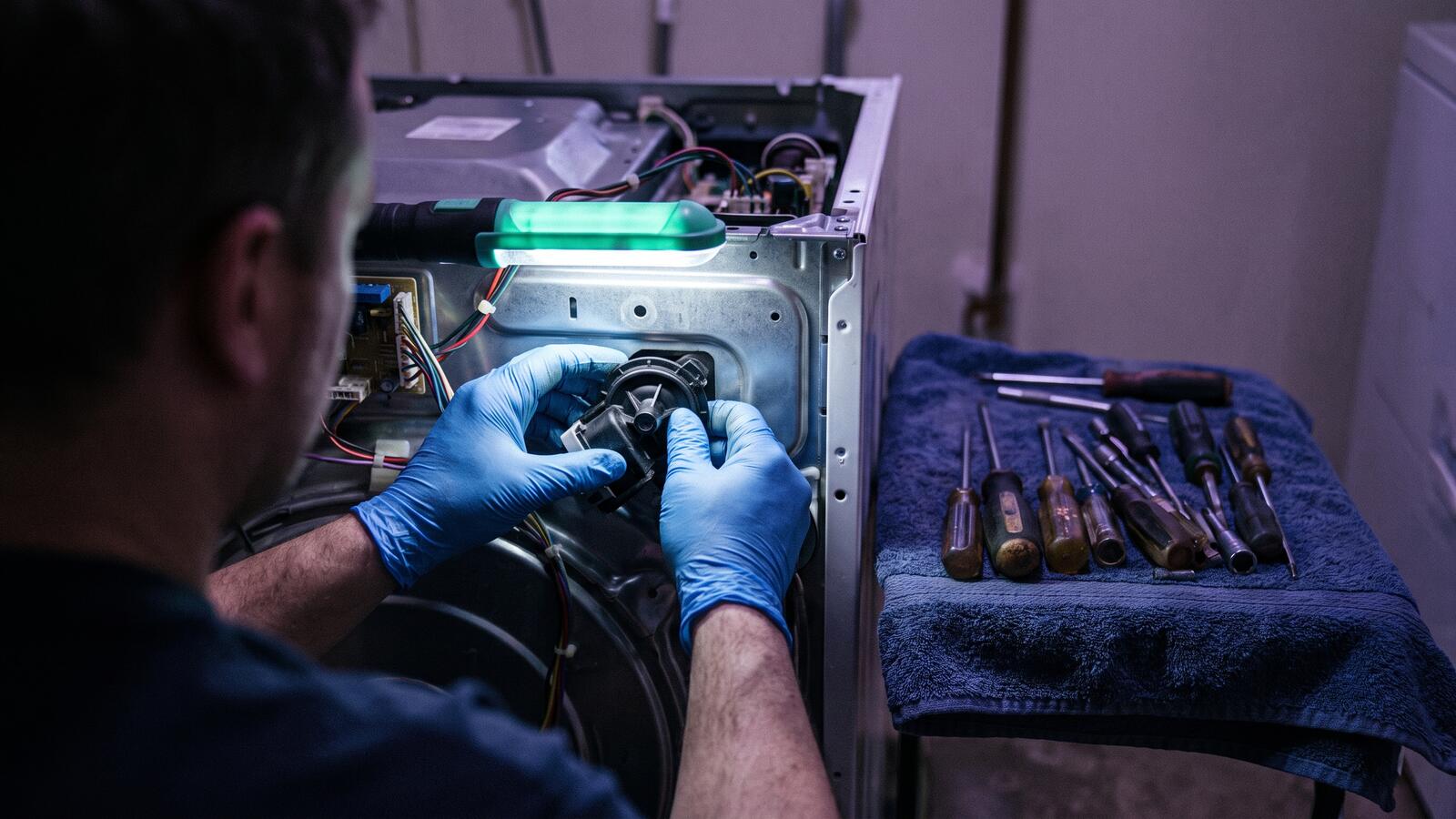
This course teaches what a technician actually does, which is less mysterious than it looks: confirm the symptom, split the machine into blocks that can be tested independently, measure at the boundary, and let the measurement say which side the fault is on. That method is identical on a dishwasher, a furnace, a lawnmower and a car, and it needs a $30 multimeter, a phone camera and a wiring diagram that is usually taped inside the machine you are standing in front of.
It also draws a line and never crosses it. This course names the exact point at which you stop and call a licensed trade, and it names the trade. Gas, sealed refrigerant systems, and anything upstream of a service disconnect are on the far side of that line in every module. The course is as clear about the repairs you should hire out as it is about the ones you should not.
When you finish, you can
- Diagnose a fault by measurement rather than by search-result guesswork, and record the diagnosis in a form a technician can read.
- Prove a circuit dead using the three-point method before a probe or a hand goes into it.
- Test a switch, a thermal cutout, a thermistor, a heating element and a motor, and tell a failed capacitor from a seized bearing.
- Trace a fill, drain, heat or airflow fault on a washer, dryer, dishwasher or refrigerator to one component.
- Separate a refrigerator fault you may repair from a sealed-system fault you must not touch.
- Run the full seasonal HVAC service a homeowner may legally do, and describe an ignition sequence precisely enough that the technician brings the right part.
- Get any small engine running again by testing fuel, spark, air and compression in that order — and lay it up so the fault never recurs.
- Build a real vehicle maintenance schedule from the service manual, and read a trouble code as the start of a diagnosis rather than a shopping list.
- Compute cost-per-remaining-year for a repair against a replacement and make the call before you are half-way into the machine.
- Name, for any job, whether it crosses the line — and which licensed trade it belongs to.
Who should not buy this
- Anyone looking for permission to work on gas, sealed refrigerant, or the supply side of a service disconnect. This course says no in every module.
- Somebody who wants a specific model's repair procedure. This teaches the method; the service manual has the procedure.
- A landlord looking to avoid licensed trades on rented property. Habitability duties do not bend to a course certificate.
The modules
All 7, with every lesson title.
Diagnose Before You Buy a Part
The single most expensive habit in home repair is buying the part the internet guessed at. A diagnosis is a measurement, and it costs nothing.
- The parts cannon
- The four tools and what each one answers
- Splitting the machine into testable blocks
- The line you do not cross
Worksheet — Diagnostic log
| Step | Boundary tested | Expected reading | Actual reading | What this rules out | Next test |
|---|---|---|---|---|---|
| EXAMPLE — dishwasher will not fill | Voltage at the inlet valve terminals during the fill step | ≈120 V AC | 0 V AC | Rules out the valve itself; the control is not commanding the fill | Test the float switch and the door interlock in series ahead of the valve |
| Symptom, exactly as observed | — | — | — | — | — |
| Model and serial number | — | — | — | — | — |
| Wiring diagram located? | Usually taped inside the lower access panel | — | — | — | — |
| — | — | — | — | — | — |
The Electricity You Can Measure Safely
Enough electrical theory to take a reading that means something, and enough discipline to never take one you should not.
- Volts, amps and ohms, in practice
- Continuity, and proving a circuit dead
- Switches, thermostats and sensors
- Motors and what actually kills them
Worksheet — Safe-measurement checklist and reading sheet
| Step | Done | Note |
|---|---|---|
| Appliance unplugged, or breaker off AND locked/tagged | — | — |
| Tester proved on a known live source | — | — |
| Circuit tested — confirmed dead | — | — |
| Tester proved again on the known live source | — | — |
| Capacitors discharged (if the machine has any) | — | Motor-run and motor-start capacitors hold a charge after power is removed |
The Big Four Appliances
Washer, dryer, dishwasher, refrigerator. The same five failure families account for most of what goes wrong with all four.
- Water in, water out
- Heat and airflow
- The refrigerator you can fix, and the part you cannot
- Seals, bearings and noise
Worksheet — Appliance triage sheet
| Check | Washer | Dryer | Dishwasher | Refrigerator |
|---|---|---|---|---|
| Power present at the machine | — | — | — | — |
| Door / lid interlock closing | — | — | n/a | n/a |
| Water supply open and screens clear | — | n/a | — | Ice line only |
| Drain clear (hose, pump, filter, check valve) | — | n/a | — | Defrost drain |
| Airflow unrestricted (vent, coils, fans) | n/a | — | n/a | — |
Heat, Cooling, and the Line
Filters, thermostats, condensate, coils and blower motors are yours. Gas trains and refrigerant are not. Knowing which is which saves both money and lungs.
- The maintenance that is most of it
- Thermostats and control wiring
- When it is the gas side
- Carbon monoxide and the non-negotiables
Worksheet — Seasonal HVAC service sheet
| Task | Owner or technician | Spring date | Autumn date | Note |
|---|---|---|---|---|
| Replace filter, record size | Owner | — | — | — |
| Clean outdoor condenser coil, clear 600 mm around it | Owner | — | — | — |
| Clear and flush condensate line and pan | Owner | — | — | — |
| Check and correct thermostat schedule and batteries | Owner | — | — | — |
| Inspect and clear return grilles and supply registers | Owner | — | — | — |
Small Engines
Mowers, generators, pressure washers, blowers. Four things make a small engine run, and nine times out of ten it is the fuel.
- Fuel, spark, air, compression
- The carburettor and stale fuel
- Storage that prevents the fault entirely
- Generators and load
Worksheet — Small-engine service and lay-up card
| Item | Value | Last done | Note |
|---|---|---|---|
| Machine, model, serial | — | — | — |
| Spark plug type and gap | — | — | From the manual, not from memory |
| Oil type and capacity | — | — | — |
| Air filter part number | — | — | — |
| Fuel: ethanol-free or stabilised | — | — | — |
The Vehicle Wear Items
The maintenance a shop charges the most margin on, done in a driveway with hand tools, and the jobs that are worth paying for.
- Fluids and filters, and the intervals that are real
- Brakes, honestly
- Tyres, and the cheapest safety you can buy
- Reading a code without obeying it
Worksheet — Vehicle maintenance ledger
| Item | Manual interval | Last done (date / odometer) | Next due | DIY cost | Shop quote | Decision |
|---|---|---|---|---|---|---|
| EXAMPLE — engine oil and filter | From the service manual, not the door sticker | — | — | — | — | DIY |
| Cabin and engine air filters | — | — | — | — | — | — |
| Brake pads front / rear (measure thickness) | — | — | — | — | — | — |
| Brake fluid | — | — | — | — | — | Usually shop |
| Tyres: pressure, rotation, date code | — | — | — | — | — | — |
Repair or Replace
The arithmetic that decides, written down before you are emotionally invested in a machine you have already half disassembled.
- The fifty-percent rule, and why it is usually wrong
- Parts availability as a signal
- The jobs worth paying for
- Keeping the record
Worksheet — Repair-or-replace calculator
| Line | Repair | Replace |
|---|---|---|
| Parts cost | — | Purchase price |
| Labour: your hours x what your time is worth, or the quote | — | Delivery and installation |
| Disposal or trade-in | — | — |
| Total cost | — | — |
| Expected remaining service life, years | — | Typical service life for the class of machine |
On completion
Pass the final assessment and the certificate is issued the same minute.
The final assessment draws from every module and shuffles. There is no limit on retakes and no time limit on the course.
This certifies that
has completed every lesson and passed the written assessment for every module of this course.
Every outside number in this course comes from one of these
- EPA Section 608 — technician certification for refrigerant work — https://www.epa.gov/section608
- CPSC Carbon Monoxide Information Center — https://www.cpsc.gov/Safety-Education/Safety-Education-Centers/Carbon-Monoxide-Information-Center