Curriculum / Occupancy
The Occupancy Course
Turn empty park pads into monthly rent from local tenants, using refurbished salvage motorhomes bought, moved and finished under a $7,500 all-in cap.
What this is
A recreational-vehicle park in the United States runs roughly two thirds full across a year, and the third that is empty moves with the calendar rather than with your sign, your website or your rates. The mortgage, the tax, the insurance and the manager cost the same in February as in July. That is not a marketing problem. It is an inventory problem: you own hookups, a slab and an address, and for most of the year nothing is sitting on them.
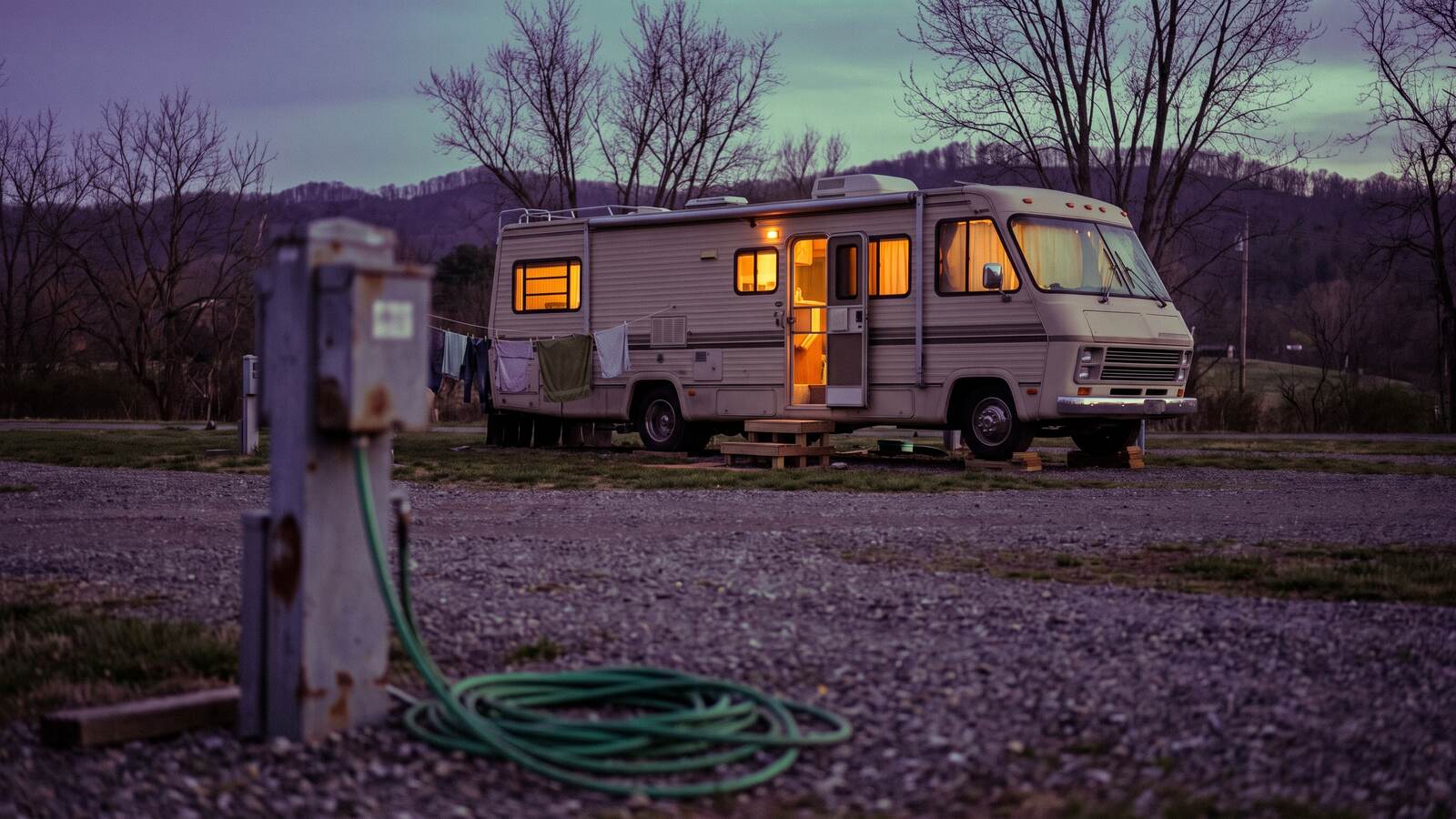
This course teaches the one conversion that fixes it. You place a refurbished salvage Class A motorhome on the pad — bought at auction, hauled in as freight, and finished to a fixed thirty-day scope, all inside a $7,500 cap — and you rent it by the month to somebody who already lives within twenty minutes of your gate and cannot afford any apartment in the county. The pad stops being a campsite and becomes a small furnished rental home.
Ten modules take that from the thesis to the ledger: the arithmetic that decides whether it works in your market, where the units are and which damage is fatal, how a unit that does not drive gets to your pad and level on it, the thirty-day refurb that keeps the number under the cap, the day-count that turns a guest into a tenant in your state, the lease structures and the utility billing, where the local tenant is already looking, rent day and the collections ladder, and the six ways the whole thing dies. You score those six before you buy anything.
When you finish, you can
- Compute the occupancy gap on your own park, in pad-months and in dollars, from your own booking history.
- Price a converted pad against the transient revenue it replaces, and state the payback in months rather than in feel.
- Read a salvage auction listing and tell a discount (dead engine, missing keys, hail) from a rejection (a wet ceiling) before you bid.
- Set a maximum bid by arithmetic that leaves transport and the whole refurb scope inside the $7,500 cap, and hold to it.
- Move a non-running Class A as freight, prep the pad, and set the unit level, blocked, secured and connected.
- Run the thirty-day refurb to a fixed scope with a tracker that shows the day the unit goes over the cap.
- Ask your own state, county and insurer the four questions that decide whether the model is legal where you stand — and know which answers stop the project.
- Choose between a pad lease, a unit rental and a rent-to-own, and say out loud why the third one is usually a trap.
- Write the ad, screen every applicant the same way, and run a move-in that ends with a signed file and a tenant who knows where the water shutoff is.
- Run rent day, the maintenance cadence and a collections ladder that ends in your statute's process and never in a padlock.
Who should not buy this
- Anyone who wants a passive investment. This is an operating business with tenants in it.
- A park whose county has already said no in writing. Module 6 tells you how to find out before you spend.
- Anybody looking for a legal shortcut around tenancy law. Every module points the other way.
The modules
All 10, with every lesson title.
The Local-Tenant Thesis
Why transient occupancy has a ceiling, why it collapses in winter, and who the local tenant actually is.
- Why transient occupancy caps out
- The 28-night shift is already happening
- Who the local tenant is
- What you are really selling
Worksheet — Occupancy gap calculator
| Line | Example value | How to get it | Notes |
|---|---|---|---|
| Total pads | 40 | Count every pad with hookups. | Include pads you use for storage or staff; they count as inventory. |
| Pads you keep transient | 20 | Your choice: the best-located, best-view pads. | The model does not ask you to give up the summer business. |
| Pads available to convert | 20 | Total pads minus pads kept transient. | These are the pads the rest of the course is about. |
| Current annual occupancy, transient pads | 65% | Nights sold in the last 12 months divided by nights available. | National average is roughly 65 to 67 percent per https://software.roverpass.com/blog/rv-park-industry-stats |
| Current winter occupancy | 30% | Same calculation, December through February only. | Winter range nationally is 15 to 55 percent per the same source. |
Unit Economics
What a pad rents for, what a mobile home really costs to place, the $7,500 unit, and payback in months.
Worksheet — Per-unit ROI sheet
| Line | Example | Your number | How to compute |
|---|---|---|---|
| Salvage purchase incl. auction fees | Your quote goes here | — | Your winning bid plus buyer fees and any broker fee. Module 3. |
| Transport to park | Your quote goes here | — | Quote from your hauler for the actual distance. Module 4. |
| Refurb, standard scope | Your quote goes here | — | Materials plus paid labor plus inspections. Module 5. |
| All-in unit cost (cap) | $7,500 | — | Sum of the three lines above. Must be at or under $7,500. |
| Monthly rent, pad plus unit | $650 | — | Your market. Rural pad rent $350 to $700, metro $1,200 and up per https://latestcost.com/average-cost-of-long-term-rv-parks/; unit rents above bare pad. |
Sourcing Salvage Class A Units
Where the units are, what the title types mean, which damage is cosmetic and which is fatal, and how to bid without blowing the cap.
- Where the units are
- Title types and what they mean for you
- Cosmetic versus fatal damage
- Reading a listing end to end
- Bidding under the cap
Worksheet — Auction bid sheet and inspection checklist
| Section | Item | Your entry | Rule |
|---|---|---|---|
| Bid sheet | Auction and lot number | — | IAA https://www.iaai.com/Vehiclelisting/Rvs or Copart https://www.copart.com |
| Bid sheet | Year, make, model, length | — | Length must fit the pad and the hauler's trailer. |
| Bid sheet | Title type | — | Confirm your state will transfer this brand to you before bidding. |
| Bid sheet | Run-and-drive status; does it roll? | — | Not running is fine. Not rolling changes the transport method. |
| Bid sheet | Yard location and distance to park | — | Get the transport quote for this yard before the sale. |
Transport and Placement
Getting a unit that does not drive from the auction yard onto your pad, level, connected, and secured.
Worksheet — Vendor list template
| Role | Vendor name | Phone / email | Quoted rate | Last actual | Notes |
|---|---|---|---|---|---|
| Hauler, heavy recovery or RV transport | — | — | — | — | Trailer type, insurance certificate on file, free-window pickup. |
| Hauler, backup | — | — | — | — | — |
| Handyman / small contractor | — | — | — | — | Has worked inside an RV; can do subfloor and cabinetry. |
| Handyman, backup | — | — | — | — | — |
| Licensed propane technician | — | — | — | — | Inspection document required before any tenant moves in. |
The 30-Day Refurb
A standard scope, a fixed calendar, and a budget tracker that stops the unit from going over the cap.
- The scope that fits the cap
- Week one: strip, seal, and water-test
- Weeks two and three: systems
- Week four: finish, punch, and photographs
- Budget discipline and the tracker
Worksheet — 30-day schedule and $7,500 budget tracker
| Block | Week / Category | Item | Owner / Vendor | Done or $ spent |
|---|---|---|---|---|
| Schedule | Week 1 | Strip soft goods, empty cabinets and bays | Handyman | — |
| Schedule | Week 1 | Interior moisture inspection with meter | Owner | — |
| Schedule | Week 1 | Roof: clean, remove failed sealant, reseal all seams and fixtures with the correct product | Handyman | — |
| Schedule | Week 1 | Windows, slide seals, compartment doors, marker lights resealed | Handyman | — |
| Schedule | Week 1 | Water test, sustained, section by section; record date in file | Owner + handyman | — |
Permits, Zoning, Insurance
The day-count that turns a guest into a tenant, how to screen your own state and county, and what to ask your insurance agent.
Worksheet — Jurisdiction screening checklist
| Question | Arizona example | Your state / county answer | Source, name, date | Attorney reviewed |
|---|---|---|---|---|
| Is there a consecutive-day count after which an RV occupant is a tenant? | Yes. More than 180 consecutive days per https://www.azcourts.gov/legalinfohub/Legal-Info-Sheets/Landlord/Tenant-Disputes-amp-Eviction/Arizona-Recreational-Vehicle-RV-Long-Term-Rental-Space-Act-Evictions | — | — | — |
| Which statute governs the tenant after the trigger? | Arizona Recreational Vehicle Long-Term Rental Space Act, per the same sheet | — | — | — |
| Could a park-owned RV be treated as a mobile or manufactured home under state law? | Check with attorney | — | — | — |
| What eviction process applies to a long-term RV space tenant? | Court process described on the same sheet | — | — | — |
| Does the county zoning code allow long-term residential occupancy of an RV on a permitted RV space? | Varies by county; ask planning in writing | — | — | — |
Lease and Tenancy Structure
Pad lease, unit rental, or rent-to-own; deposits; utility billing; and the documents your attorney reviews before you use them.
Worksheet — Lease outline
| Section | What it covers | Decision you make | Attorney review |
|---|---|---|---|
| Parties and premises | Landlord, tenant(s), unit identifier, space number | One lease per unit; all adult occupants sign | Required |
| Term | Month to month or fixed term; renewal; how either side ends it | Month to month is common for the first tenant; notice periods per statute | Required |
| Rent | Amount, due date, payment method, grace period, late fee | Set from Module 2; late fee within state cap | Required |
| Deposit | Amount, where held, deductions allowed, return deadline | Within state cap; separate account if required | Required |
| What is included | Furnished unit, pad, hookups, trash, any park services | Cross-reference utility addendum | Required |
Finding and Screening Local Tenants
Where local demand lives, how to write the ad, how to screen fairly and firmly, and how to run the showing and the move-in.
Worksheet — Ad copy template and screening script
| Block | Line | Template text | Fill in from |
|---|---|---|---|
| Ad | Headline | Furnished one-bedroom with private bath and full kitchen, monthly, [town] | Your unit and town |
| Ad | What it is | Clean, dry, furnished one-bedroom in a quiet park. Set motorhome on a permanent space; it does not move and the rent reflects that. Real bedroom door, private bath with shower, full kitchen, heat and air. | Module 5 punch list; note the bedroom door |
| Ad | Rent and deposit | $[rent] per month. $[deposit] deposit. [Utilities included / flat $[x] utilities / electricity submetered at cost]. | Module 2 rent; Module 7 utility addendum |
| Ad | Included | Furnished, mattress, blinds, trash, [laundry], [internet]. One vehicle space. | Park services |
| Ad | Who it is for | Working adult. Income verified, background checked, renters insurance required. [Pets: yes with terms / no]. Maximum [n] occupants. No smoking inside. | Your written criteria |
Operations and Collections
Rent day, the maintenance cadence that keeps a unit dry, the collections ladder, and the records that prove all of it.
Worksheet — Monthly operations checklist
| Block | Task | When | Done / Value |
|---|---|---|---|
| Rent | Statements sent to every tenant | Before the 1st | — |
| Rent | Payments recorded in the ledger by unit | As received | — |
| Rent | List of tenants unpaid after due date | Day 2 | — |
| Collections | Friendly reminder to each unpaid tenant | Day 2 | — |
| Collections | Late fee posted; written second contact with total and deadline | Day after grace period ends (per lease) | — |
What Kills the Deal
County bans, unit rot, the tenant who removes the unit, eviction timelines, rent-to-own traps, and over-improvement. Score each one before you buy.
- County bans
- Unit rot
- The tenant removes the unit
- Eviction timelines
- Rent-to-own traps and over-improvement
Worksheet — Deal-killer scorecard
| Risk | Score 1 (low) looks like | Score 5 (high) looks like | Evidence required for a low score | Your score | Next action |
|---|---|---|---|---|---|
| County ban | Planning department answered yes in writing; permit allows long-term spaces; units inside permit count | No written answer, or permit silent and unasked, or complaint history | Dated email from planning; copy of permit; jurisdiction checklist complete and attorney-reviewed | — | — |
| Unit rot | Inspected at yard with meter; week-one seal and water test dated; roof inspected spring and fall | Bought on photos only; water test skipped; nobody on the roof in a year | Inspection checklist; water-test date in unit file; roof inspection dates on ops checklist | — | — |
| Tenant removes the unit | Title in park's name in file; unit placarded; set on blocking with wheels stored or locked; lease clause initialed | Title unclear; unit on tires with hitch open; no placard; lease silent | Title copy; photograph of placard and setup; initialed lease clause | — | — |
| Eviction timeline | Attorney counted the weeks; screening criteria written and applied; collections ladder followed on the day; reserve covers one eviction a year | Weeks unknown; screening informal; reminders ad hoc; no reserve | Attorney's written estimate of weeks; screening criteria document; ledger and notice records; reserve balance | — | — |
| Rent-to-own trap | Not used; or used only under an attorney-drawn installment agreement with state rules confirmed | Verbal or template rent-to-own; tenant believes unit is theirs | Attorney's document or a written decision not to use it | — | — |
On completion
Pass the final assessment and the certificate is issued the same minute.
The final assessment draws from every module and shuffles. There is no limit on retakes and no time limit on the course.
This certifies that
has completed every lesson and passed the written assessment for every module of this course.
Every outside number in this course comes from one of these
- RoverPass — RV park industry statistics — https://software.roverpass.com/blog/rv-park-industry-stats
- LatestCost — average cost of long-term RV parks — https://latestcost.com/average-cost-of-long-term-rv-parks/
- Manufactured Housing Consultants — installation cost guide — https://manufacturedhousingconsultants.com/manufactured-home-installation-cost-complete-guide/
- IAA — RV listings — https://www.iaai.com/Vehiclelisting/Rvs
- Copart — https://www.copart.com
- Arizona Courts — RV Long-Term Rental Space Act — https://www.azcourts.gov/legalinfohub/Legal-Info-Sheets/Landlord/Tenant-Disputes-amp-Eviction/Arizona-Recreational-Vehicle-RV-Long-Term-Rental-Space-Act-Evictions